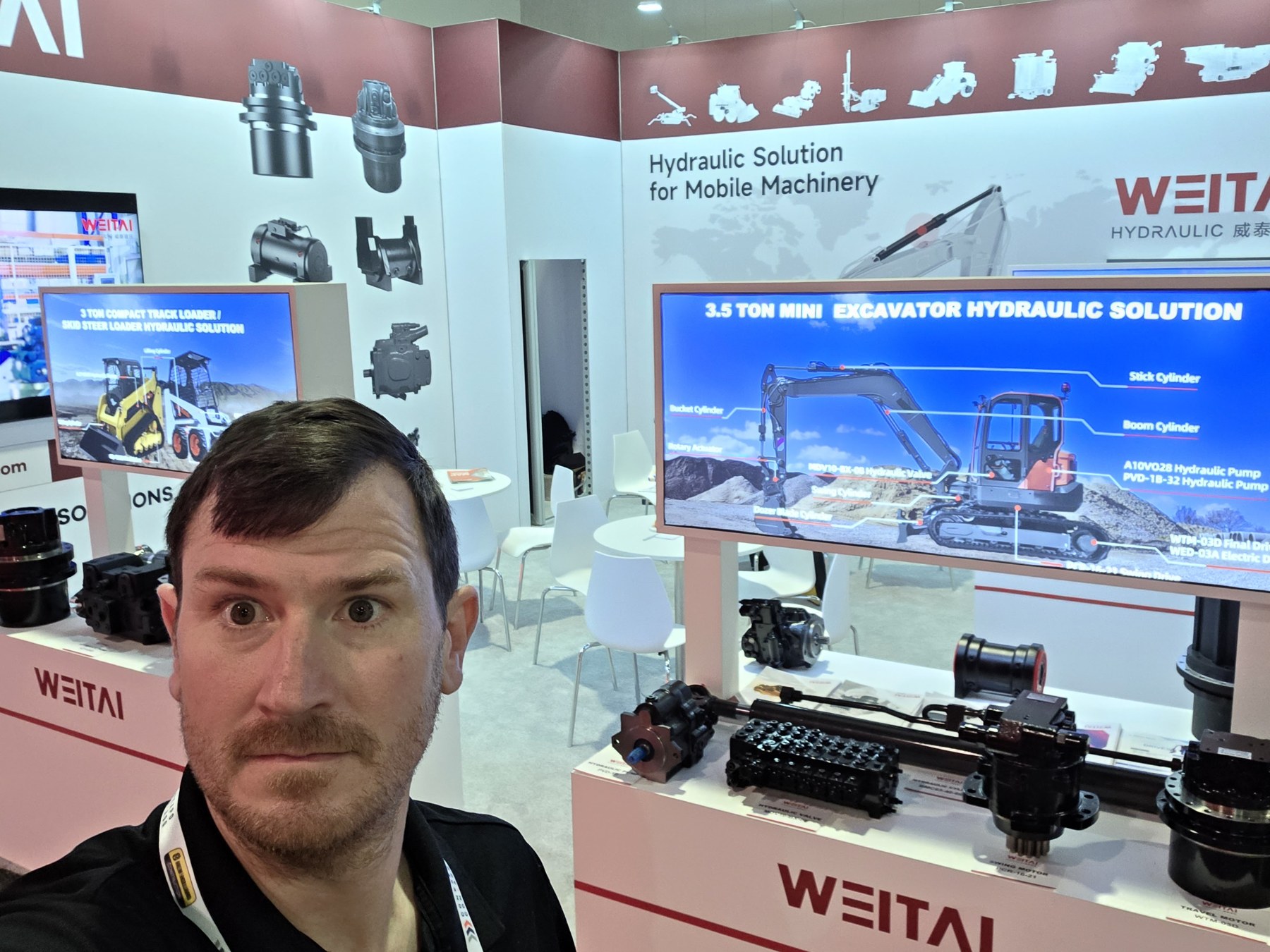
The photograph puts me at the WEITAI display, with hydraulic components across the counter and screens showing how they fit into mobile machines. The display is organized around applications: a compact track loader on one screen, a mini excavator on another. The sales proposition reaches beyond an isolated replacement part.
A manufacturer presenting a system
WEITAI identifies its headquarters as Qingdao, China. Its CONEXPO announcement placed its exhibit on South Hall’s second level and listed final drives, piston pumps, cylinders and rotary actuators, along with system integration. Those are the company’s stated product scope and exhibition plans, not independent findings about the performance of the units on the counter. Company profile · CONEXPO announcement.
In my photograph, the arrangement makes that scope tangible. A buyer can look from a component to a drawing of the machine it is intended to serve. That is a useful commercial connection. It does not establish that the displayed combination has been accepted for an American OEM’s particular design, but it shows how the manufacturer presents its place in the machine.
The American question is about capability
My concern is what American businesses can develop and sustain on their own terms. Meeting an overseas manufacturer should sharpen that question. Which part of the job could a domestic business perform? What would it need to design, machine, assemble, test or support? Where does it already have an advantage, and which missing capability prevents it from taking the next step?
A serious response has to identify an application and the work needed to win it. It cannot end with a flag on the finished machine or a promise to buy locally. It also cannot assume that an unfamiliar supplier lacks capability merely because it is based abroad. The evidence has to follow the product, the application and the ability to keep supplying it.
This stand is one concrete place to begin that examination. My photograph records the encounter with the display. The company’s own information identifies its offering. An assessment of competitive performance would require qualified comparisons and customer evidence that neither the photograph nor the marketing material supplies.