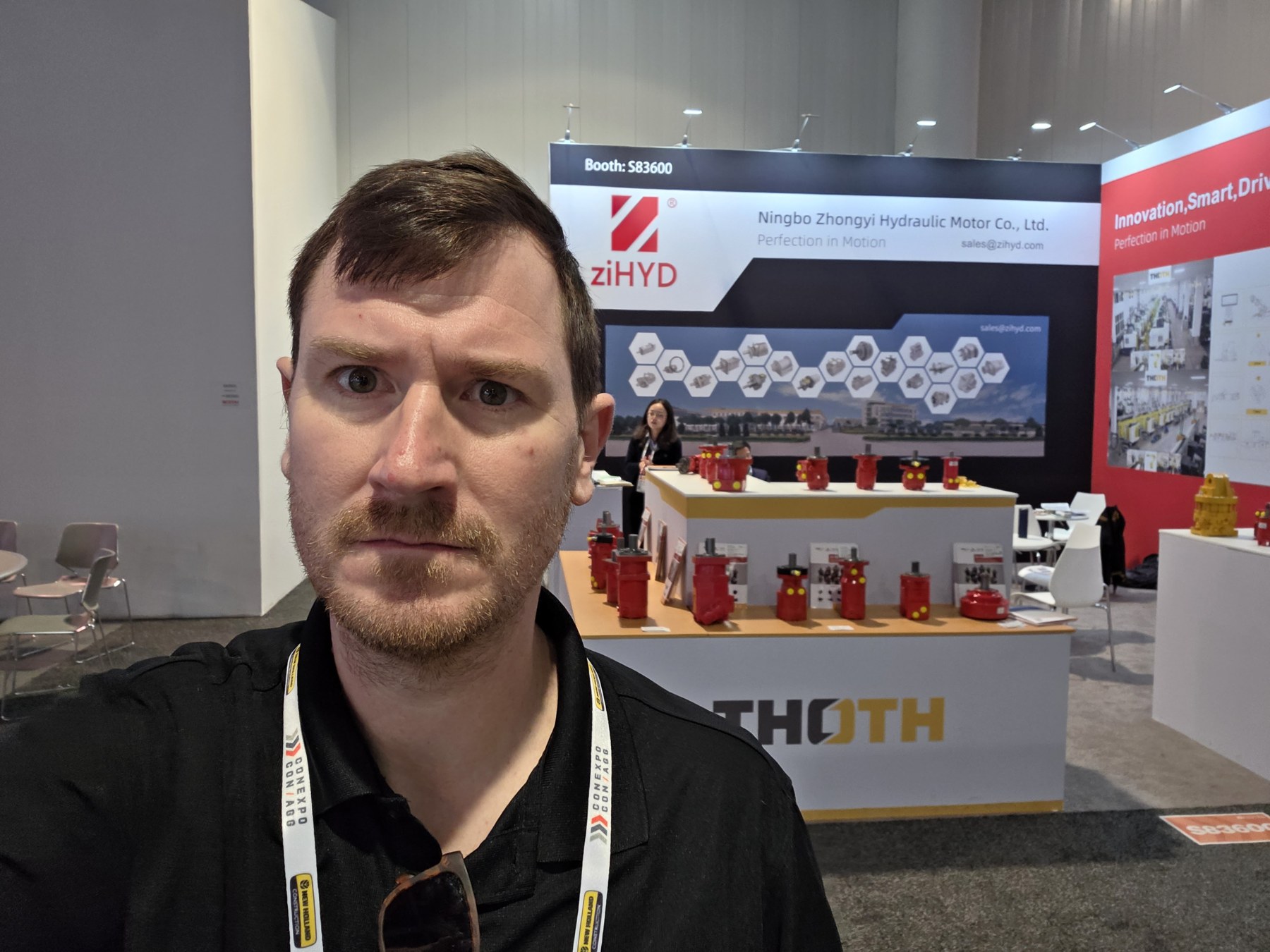
The name across the back of this stand is explicit: Ningbo Zhongyi Hydraulic Motor Co., Ltd. The ziHYD mark appears above the display, with THOTH on the counter. Red motor housings fill the tables behind me. Here, the hydraulic motor is the central subject of the exhibit.
Put a name to the manufacturer
Zhongyi’s own website identifies its Ningbo, Zhejiang address and lists orbital motors, radial-piston motors, hydraulic transmissions, winches and steering units. That gives the photograph a more precise context than a general reference to “Chinese equipment.” It is a named manufacturer presenting identifiable product families. Zhongyi’s company and product information.
The photograph does not tell us the displacement, rating, performance or approval status of every unit displayed. Nor does it establish that one can replace a motor in an existing machine. Those are application questions. A familiar housing and a similar catalogue description are reasons to investigate, rather than evidence of interchangeability.
A competitor deserves a specific comparison
My argument about American industrial leadership becomes more useful when it reaches this level of detail. Which product does an equipment builder need? Who owns the design, who can make it repeatedly, and which organization can qualify and support it? Asking those questions of a named supplier is more productive than treating an entire country as a single business.
For an American manufacturing proposal, I would want the same specificity: the process to establish, the customer requirement to meet and the reason that investment could earn continuing business. The people building and selling the product need a credible path between those points.
The failure I am arguing against is a leadership approach that celebrates the commercial transaction while paying too little attention to the productive capability left afterward. This photograph does not prove that argument by itself. It makes the competitive landscape visible and supplies a concrete manufacturer to examine within it.